
TikTok SMM Service Quality Checklist: Source, Speed, Retention, Targeting and Support
A TikTok SMM service should not be judged by one label such as “high quality” or “fast.” Service quality is a combination of what the provider documents, how the order operates and what can be observed during and after delivery.
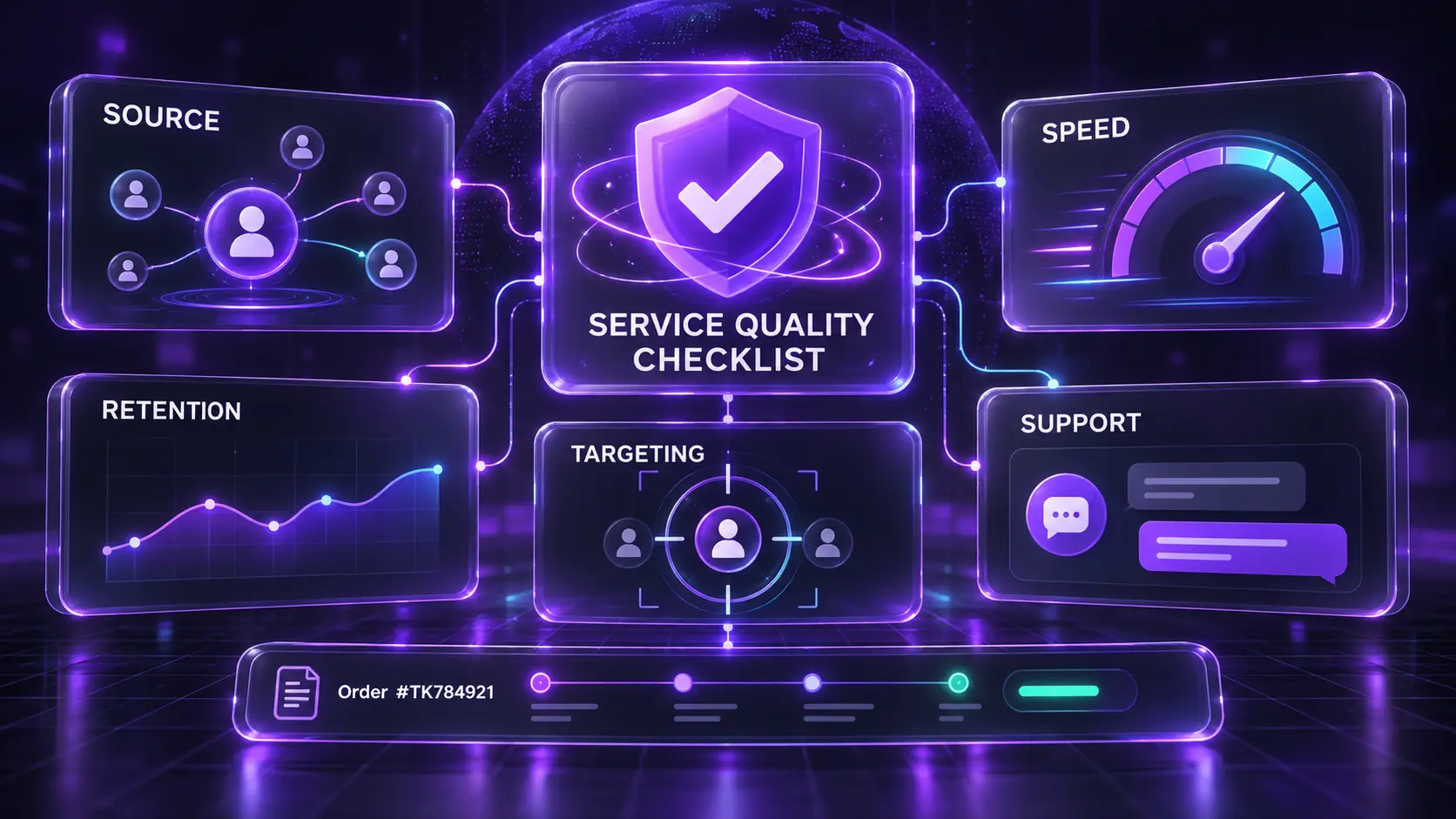
The main evaluation dimensions are source, delivery speed, delivered quantity, retention, targeting and support. Each answers a different question. A service may deliver the requested quantity quickly but provide weak targeting. Another may deliver slowly while remaining within its stated terms. Combining these outcomes into a single quality score can hide the information needed for a purchasing decision.
Whether you are evaluating a service on Tiksta or elsewhere, separate provider statements from documented terms and observable order results. Anything that cannot be verified should remain classified as uncertain.
What Is TikTok SMM Service Quality?
TikTok SMM service quality describes how closely an order’s documented terms and observable results match the buyer’s requirements.
This definition does not assume that every provider uses the same delivery system. An SMM panel may manage orders through a dashboard, send them through an API or divide delivery into drip-feed cycles. The applicable service description determines what was offered.
Quality should be evaluated across separate dimensions:
| Dimension | What it evaluates |
|---|---|
| Source | What the provider states about the delivery source and what can actually be observed |
| Speed | Start delay, total delivery time and pacing |
| Delivered quantity | How much of the ordered quantity was recorded as delivered |
| Retention | How the delivered quantity changes during a defined observation window |
| Targeting | Whether observable delivery matches the selected targeting criteria |
| Support | Whether questions, errors and policy requests receive clear, traceable responses |
Delivery alone does not prove retention. Retention does not prove targeting. Targeting does not prove that an order will generate organic engagement or business results.
Use an Evidence-Based Evaluation Method
A quality assessment should connect each conclusion to a specific record. The strongest record depends on what is being evaluated.
Separate Claims, Terms and Results
A provider statement is a general claim made on a website, advertisement or sales page. Phrases such as “premium source,” “real users” or “high retention” belong in this category unless the provider defines them.
Documented terms are the conditions attached to the selected service. These may include the supported link format, minimum and maximum quantity, start time, estimated speed, targeting options, refill coverage and exclusions.
Observable results are what the dashboard, API, TikTok account and support history show after an order is placed. They can establish that something happened, but they may not reveal why it happened or where every delivered unit originated.
| Evidence type | What it can support | What it cannot prove alone |
|---|---|---|
| General provider statement | What the provider claims | Performance of a particular order |
| Dated service description | Terms presented for the selected service | Whether the service will perform exactly as described |
| Dashboard or API record | Order ID, status, quantities and timestamps | Organic impact or permanent retention |
| TikTok count observation | Visible change at a recorded time | Which order caused the change |
| Profile sample | Observable characteristics of sampled accounts | Ownership, origin or future activity |
| Support record | How a reported issue was handled | Overall quality across every order |
When records conflict, do not silently select the most favorable one. Record the conflict and treat the conclusion as unresolved.
Record the Relevant Inputs and Outputs
The order record should identify the input sent to the service. Relevant fields may include:
| Input field | Evaluation purpose |
|---|---|
| Service ID and service name | Identifies the exact terms being evaluated |
| Target URL or username | Connects the order to the correct TikTok profile, post or LIVE |
| Ordered quantity | Records the requested amount |
| Targeting selection | Records any country, language or other available targeting input |
| Drip-feed settings | Separates one-time delivery from scheduled cycles |
| Submission timestamp | Establishes the beginning of the order timeline |
The resulting output record may include the provider order ID, starting count, delivered quantity, remaining quantity, current status and status timestamps. If the order was submitted through an API, preserve the provider response and order identifier alongside the dashboard record.
Do not assume that an API response, dashboard status and public TikTok count update at the same moment. Each is a separate data source.
Interpret Status and Error States Correctly
Status terminology varies between providers. A dashboard may use labels such as pending, processing, completed, partial or canceled, but the provider’s own documentation should define what those labels mean.
A completed status normally indicates that the provider considers fulfillment complete. It does not prove permanent retention, targeting accuracy or organic performance.
A partial status indicates that less than the ordered quantity was recorded as delivered. A canceled or rejected order may point to an input problem, an inaccessible target or another documented service condition. The exact cause should come from the order record or support response rather than assumption.
Evaluate the Source Claim
“Source” can refer to several different things: the delivery network, supplier, account pool, traffic origin or method used to produce the ordered metric. A useful evaluation begins by asking the provider to define the term.
Check whether the selected service description explains what the source claim means. A broad claim elsewhere on the website should not replace terms attached to the exact service.
Next, identify what can be observed. For follower or engagement services, this may involve reviewing a sample of visible profiles for the characteristics relevant to the provider’s claim. For view services, public counters may show delivery but reveal little about the underlying audience.
A profile sample can document visible language, content, location indicators or activity at the observation time. It cannot establish account ownership, original acquisition source or future behavior. Claims about authenticity should therefore remain unverified unless supported by appropriate evidence.
A stronger source assessment contains a precise provider definition, applicable written terms and observable results that do not contradict those terms. When the source cannot be independently verified, record it as uncertain rather than automatically passing or failing the service.
Evaluate Delivery Speed and Quantity Separately
Speed has at least three parts: start delay, delivery duration and pacing.
Start delay is the interval between order submission and the first observable delivery. Delivery duration is the interval between the first delivery and the order’s final recorded state. Pacing describes how delivery was distributed during that period.
Record the order timestamp, first observed change, status transitions and completion timestamp. If the service uses drip feed, record each cycle separately. A single completion timestamp cannot show whether delivery was steady, concentrated or interrupted.
Delivered quantity requires its own assessment. Use the provider’s delivered quantity and relevant count observations rather than the original order amount alone. A request for 10,000 units does not establish that 10,000 were delivered when the order is partial, canceled or still processing.
Organic activity can affect the same public count during delivery. Concurrent SMM orders create an additional attribution problem. Where exact attribution is unavailable, describe the result as an observed count change rather than an order-proven quantity.
Fast delivery is not automatically better, and slower delivery is not automatically worse. The relevant question is whether the observable timeline matched the documented service terms and the buyer’s intended use.
Evaluate Retention Without Assuming Permanence
Retention describes how an observed delivered quantity changes across a defined period. It should not be treated as a permanent characteristic.
A retention window is the period selected for observing changes. A refill window is the period during which a provider may review or replace eligible drops under its stated conditions. These terms may overlap, but they do not mean the same thing.
A refill promise is a possible remedy. It does not prove that delivery will never drop or remain permanently. The detailed policy evaluation belongs in Tiksta’s guide to TikTok refill policies, retention windows and drop tracking.
For a service-quality assessment, preserve the relevant starting count, post-delivery observation, later observations and full timestamps. If you calculate a retained share, state the denominator. The provider-reported delivered quantity and the observed increase above the starting count may produce different results.
The observation window must also be stated. A measurement taken after one day cannot be compared directly with one taken after several weeks.
Organic follows and unfollows, overlapping orders, platform count adjustments and inconsistent observation times can all affect the result. Retention should therefore be reported as an observed pattern under defined conditions, not as proof that every change came from the order.
Evaluate Targeting Against the Exact Promise
Targeting quality can only be evaluated after defining the targeting claim.
A country-targeted service, for example, should specify whether the claim refers to profile location, language, audience origin or another attribute. These are not interchangeable. A service described only as “targeted” does not provide enough information for a precise test.
Record the targeting option selected with the order. Then define which observable characteristic will be checked and how the sample will be selected.
When a sample is used, report both the number of profiles reviewed and the number that could actually be evaluated. Private profiles, missing biographies and ambiguous content can reduce the usable sample.
The relevant proportion can be recorded as:
Observed targeting match = Profiles matching the stated criterion ÷ Profiles that could be evaluated
This figure describes the sample, not the full delivery population. It also depends on whether the selected profile characteristic is a valid indicator of the provider’s targeting definition.
Do not treat audience growth or engagement after delivery as proof of targeting accuracy. Those outcomes may be affected by content, existing audience activity, organic discovery and other promotion.
Evaluate Support Through Traceable Outcomes
Support quality is more than response speed. A quick reply that does not address the order record may be less useful than a later response that identifies the applicable terms and resolves the issue clearly.
A support evaluation should preserve the order ID, question, submission time, first response, requested evidence, final response and resulting order action.
Check whether support distinguishes between the ordered quantity and delivered quantity, refers to the correct service description and explains relevant status or error states. For refill questions, support should connect the response to the applicable service terms rather than a general promise.
The final outcome may be clarification, correction, refill review, partial adjustment, cancellation explanation or a finding that the available evidence does not support the request. The quality assessment should record what happened without assuming that every buyer request must be approved.
TikTok SMM Service Quality Decision Table
Use the table before purchase and update it after delivery. It is intentionally not a weighted score because different buyers and use cases require different priorities.
| Dimension | Evaluation questions | Strongest available evidence | What may remain uncertain |
|---|---|---|---|
| Source | Is the source claim defined? Is it attached to this service? | Dated service terms and relevant observable sample | Upstream origin, ownership and future account behavior |
| Speed | Are start time, delivery duration and pacing documented separately? | Order ID, timestamps, status history and count log | Exact timing when public counters update |
| Delivered quantity | Was the full amount recorded as delivered? | Dashboard or API delivery record plus consistent observations | Exact separation from organic or overlapping activity |
| Retention | What window and denominator are being used? | Post-delivery baseline, later observations and applicable terms | Which specific delivered units remained or disappeared |
| Targeting | What criterion was promised and how can it be observed? | Targeting selection, written definition and documented sample | Characteristics not visible on public profiles |
| Support | Was the response accurate, traceable and connected to the order terms? | Timestamped support history and final order action | Performance on future or unrelated cases |
An undocumented field should be classified as unknown. It should not automatically receive a positive or negative score.
How to Apply the Checklist
Before Placing the Order
Save the exact service name, service ID and description. Record the quantity limits, supported target format, stated start time, delivery speed, targeting option and refill terms.
Define what matters for the purchase. If targeting is essential, an undefined targeting claim may be a deciding limitation even when delivery speed is clear. If the order is being used to test retention, decide the observation schedule before delivery begins.
Avoid introducing multiple services or providers to the same target during the test. When overlapping activity cannot be avoided, record it as a confounding factor.
During Delivery
Record the order ID, submission time, starting count and initial status. Note the first observable delivery and each meaningful status change.
Keep ordered quantity, observed count change and provider-reported delivery separate. If the target becomes private, is removed or changes username, document when the change occurred.
For API orders, preserve the relevant request fields, provider order ID and responses. For dashboard orders, retain timestamped records of status and quantity changes.
After Delivery
Record the completion or final status, reported delivered quantity and a timestamped count observation. Continue observations according to the retention period selected before the test.
For targeting evaluation, use a consistent sampling method. For support evaluation, retain the full case history rather than only the first or final message.
TikTok provides account and post information through TikTok Studio analytics, including content, viewer and follower insights. These records can add account-level context, but they should not be presented as order-level attribution.[1]
Classify the Result
A useful conclusion describes each dimension separately.
The order may have matched its stated start time, delivered only part of the requested quantity, shown uncertain targeting and received a documented support resolution. That is more informative than calling the entire service “good” or “bad.”
The final purchasing decision can then reflect the buyer’s actual objective without pretending that every dimension carries the same importance.
Limitations and Common Misinterpretations
A dashboard is a provider-side record. It is important evidence, but it is not independent confirmation of every result.
A visible TikTok count is an account or post-level observation. It does not identify which provider, order or audience group caused each change.
TikTok notes that post views can fluctuate and directs creators to analytics for more context. This makes a single counter snapshot a weak basis for judging delivery or organic performance.[2]
A completed order does not prove that the delivery created organic reach, engagement, conversions or revenue. These are separate outcomes with additional influences.
A refill guarantee does not prove permanent retention. A targeting label does not prove that every delivered account matches the selected characteristic. A visible profile does not prove the origin or authenticity of the account behind it.
Short observation windows may miss later changes. Long windows introduce more organic activity and other confounding factors. Neither window is universally correct.
Comparison groups must also be compatible. Compare orders using the same service, targeting conditions, quantity range, target type, status classification and observation window where possible. Do not combine completed and partial orders or compare follower retention directly with view delivery.
Subsequent Measurement
Maintain a consistent record for recurring orders. Each entry should include the service ID, order ID, target, selected options, ordered quantity, starting count, submission time, status history, delivered quantity, observation timestamps, support history and any refill action.
Review patterns by dimension. Compare speed with speed, retention with retention and targeting with targeting. Do not allow strong performance in one area to erase weak or uncertain evidence in another.
Repeated comparable orders can reveal whether an outcome is consistent, but they do not eliminate uncertainty about causation. The purpose of the checklist is to improve the decision record: what was promised, what was observed, what evidence supports the conclusion and what remains unknown.
Sources
TikTok Support. “TikTok Studio.” Current documentation reviewed September 25, 2026.
TikTok Support. “My Posts Aren’t Getting Views.” Current documentation reviewed September 25, 2026.